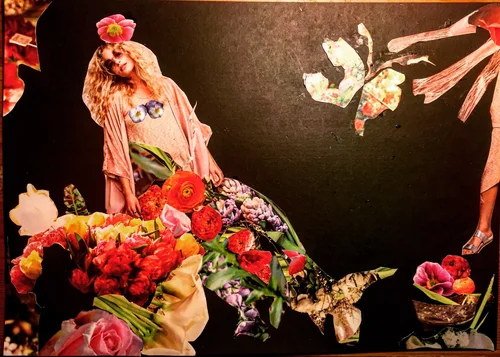
Micro-macro compositions can be an arrangement of information such as small images or words arranged in order to make one whole image which can send a message. Avante garde fashion often does not stick to what is conventional and often recreate nature or even fairy tails with it’s style and colour as it is trying to break free from what is considered the every day wear. Within this photograph it is a fun collage arrangement of different flowers found in nature arranged in a way to create a mermaid tale and add accessories to an image of a model. This crosses the line of what can be clothing and pushes the conventional ideas of how it can be worn. It also send’s the message of how clothing can be more ethical and how the materials we use can be biodegradable and not harm our planet as humans are one with nature. This poster is evident of Tufte’s theory that one singular image is able to send an message with a collection of data arranged in a certain way.
“Micro/macro designs enforce both local and global comparisons and, at the same time, avoid the disruption of context switching. All told, exactly what is needed for reasoning about information.” – Tufte (1990)
The colours arranged in front of the black background help pull us visually towards the image and helps us separate the micro images from the background in order to create the overall shape. A mermaid tail is in contrast to the background and helps us also appreciate the bright array of colours on the tail. Overall it is a visually pleasing image which can be interpreted a number of ways.
References:
Image: harumi. 2021. How to make a collage with photos -Create a big picture by small pieces- — harumi. [online] Available at: <https://www.harumiphotography.com/blog/2018/7/23/paper-art-work> [Accessed 16 November 2021].
Medium. 2021. Information Design (9/29). [online] Available at: <https://medium.com/@blakewilliford/information-design-9-29-ee995efb584e> [Accessed 16 November 2021].
Edward Tufte: Tufte. E.R., 1990. Envisioning Information. Cheshire, Connecticut: Graphics Press. (pp. 81-93).